Digital Communication

There’s a Party and Everyone’s Invited

Let’s start with this: Human beings are, in my opinion, social creatures.

True, there are differences in the levels of social engagement individuals are comfortable with, but, ultimately, there are very few people who desire no interaction with other human beings.
OLYMPUS DIGITAL CAMERA

How these interactions are carried out, however, has drastically changed over the years.
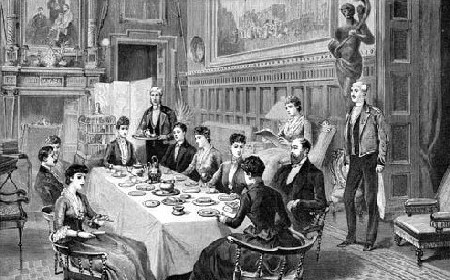
1800s Tea Party
(NOT a recent photo) See how much things have changed? When was the last tea party you attended?)

Today, one of the primary ways we develop relationships with others is through social media.
giphy6

Social media, which is characterized by conversation, interaction and engagement in the digital space, allows us to build a different sort of relationship — one where participants are not burdened with some of the messy, up-close-and-personal aspects of interpersonal communication, one where geographic distance is no longer a factor, one where “depth” is not a trait considered vitally important, and one where we can interact with anyone at any time we desire. (I acknowledge that some of that comes off as a bit cynical.)

In our society, most of us likely spend as much time on these “online” social relationships, as we do engaging in our more traditional social relationships.

The obvious question is: Why?

Why is social media so prevalent in our society and why do we spend so much time on it?

I think the answer is multi-faceted.

First, its prevalence has increased because technology has developed to a point where social media is an efficient and effective way to communicate with others. Thanks to computers, smartphones, and tablets, we can now communicate with anyone, anywhere, at any time.

Second, social media allows us to let our thoughts be known (in this case, to the entire world), even when no one else is around. If we’re honest with ourselves, we can admit that we think our opinions and thoughts are important and valuable. Social media enables us to quickly let others bask in the glory of our views on an unlimited number of topics.
giphy7

Third, social media enables us to live vicariously through others — including celebrities. If you think your life is boring, go online and watch videos of someone base-jumping. This is an extreme example, but I think all of us have been guilty of looking at posts made by our friends and wishing that we had as exciting a life. It is important to realize, however, that most people only post the “highlights.” There are some negative psychological effects related to judging the quality of your own life based on what you see online.

Finally, as I alluded to earlier, we are social creatures. If we’re lonely, we need only go to a social media site to instantly be involved in a conversation of our choice. No effort necessary. It can be hard to make friends in the real world, but online, all it takes is an Internet connection and a thought. I truly believe that the ease of engagement native to social media is extremely appealing to most people. Social media provides instant social gratification without having to leave the comfort of your home.

Despite the appeal and prevalence of social media today, I’m not certain it can last. There is a part of me that feels we are so consumed by it that, when we realize how dependent we have become (addicted, really), there may be a backlash. It would not surprise me if, in the future, many people decide to disconnect and begin experiencing life in the first-person again, without looking at the world through a screen. I don’t see this happening anytime soon, but I’ve thought about going “offline,” so to speak, and I expect others have as well.


Digital Communication

The More You Know: An Open Letter to a College Freshman

Dear college freshman (I’m sorry I don’t remember your name),

college

Congratulations! You’re almost done with your first year of school. You should be very proud of what you’ve accomplished so far, but there is much more to come. My advice to you is to enjoy every minute of your time in college, because soon you’ll join me out here in the real world and I, as a fellow member of society, have certain expectations for you.

I expect you to contribute to society in some form or fashion and in order to do that ­­— to (productively) take part in the ever-evolving national and global dialogue — you need to be media literate.

I know what you’re thinking.

“I’m already media literate,” you’re saying to yourself. “I totally understand the media.”

Do you really though?

Being media literate requires far more than a simple understanding of the various forms of media. I know you are far more technologically capable than I ever will be, but, to be truly media literate, you must not only understand the nature of media, but also how and why those producing the content conveyed via the media you know so well develop their messages. You are going to have to dig beneath the surface and look beyond what you see in your Facebook and Twitter feeds.

In other words, and I know this may be bad news, but your research days are not done when you leave college.

Here’s another tip: You can’t believe everything you see or hear.

I know. You already know that. But…think about it. How often have you seen something online, from one of your friends for example, and simply taken it at face value? I’d guess more than you’d like to admit.

If you expect to be able to offer intelligent commentary on the issues you see or hear about through the media, you have to have an understanding of all sides of the issue. You have to understand the motive behind the message. This may mean expanding your worldview. This can be uncomfortable, but it is necessary if you want to become truly media literate — as you should.

So, how do you do it? How do you ensure you’re media literate?

The answer is actually pretty simple. You work at it. You apply a basic process to what you see or hear and, through that process, you gain the competency and knowledge you need to achieve media literacy.

If you haven’t already learned about this process, you soon will. Here it is:

giphy5

  1. Description: Pay attention, take notes and research the issue.
  2. Analysis: Focus on the patterns you notice in the previous phase and, shocker, analyze them.
  3. Interpretation: (This is hard) Asking yourself the question, “What does this mean?” when looking at your findings.
  4. Evaluation: This is where you reflect on what you’ve found before moving on to:
  5. Engagement: This is where you take an action based on your findings. This is where you become the productive member of society that I have no doubt you will become.

I expect it.

Enjoy the rest of school and I’ll see you in the real world.

Best,

Eric


Digital Communication

Who’s in Charge Here?


As we, as a society, have moved through the eras of communication, it is clear that, as our methods of communication have changed, so too has our culture. It is hard to imagine someone who, in the written era of communication, was willing to wait months or years for a message from a friend or relative willing to exercise that same patience in today’s age of instant messaging.

giphy2

In fact, we now expect IMMEDIATE feedback on our missives and, if it isn’t received, we get quite upset.

giphy1

Our culture is now one that thrives on instant gratification. It’s one where I can no longer carry around my trusty telegraph to stay in touch with my acquaintances…it’s not “culturally accepted” anymore.

9593119270_5284fcddda_o

Is this change, however, a result of the media/mediums available to us, or did changes in our culture facilitate/necessitate the development of new forms of communication and the technology that enables them? Perhaps a better way to frame the question is: When it comes to culture and media/communication, which has the greater influence on the other?  The answer, I believe, is dependent on the era of communication being discussed.

Let’s take the print era of communication as our first example.

The “Print Era,” ushered in by the printing press (an invention of the venerable Johannes Gutenberg), had some undeniably positive impacts on the development of culture in the 15th century (particularly in Europe). Let’s explore a couple:

  1. There was a rapid increase in the speed with which information could be spread
  2. Literacy rates increased
  3. Faster and more efficient production of printed materials enabled more books to be printed -thereby bringing down the cost of books and enabling more people to afford them.

giphy3

Suddenly (a bit of an exaggeration), more people had access to information and those with the ability to print large quantities of their material were able to reach the masses.  Those with this ability were undoubtedly able to have a great influence on society and culture…Protestant Reformation anyone?

The importance of the printed word was so profound, in fact, that until as late as 1980, print was the dominant medium for spreading knowledge…and influence.

During this era, there was a clear delineation between content creators and content consumers, with creators far outnumbered by consumers. Nonetheless, I would argue that during the print era, due to economic and social factors, those in the mass media “biz” had a far greater impact on the consumers than vice versa.

In the digital era, this, I would posit, has changed.

giphy4

I KNOW!

Things have changed quite a bit since Gutenberg invented the printing press. Now, it might be argued that we (the masses of mass media consumership fame) have significantly narrowed the “influence gap” by creating and disseminating content of our own…quite successfully in many instances.

In fact, we, I believe, now drive what the mass media produces. Earlier, we were essentially told what was important for us to know. Gatekeepers (and relatively few of them) determined what we should watch and listen to. Today, that role falls to us. In the current era, mass media keeps one eye on their bottom line while focusing the other on what the general population is watching, creating, and talking about. What is popular online now, may be a Netflix show next. This shift can be attributed to advances in technology generally and, specifically, to digital convergence. We now have instant access to information and the ability to, with a smart phone alone, produce our own “talk show” highlighting our reaction to, and opinions on, that information. Individuals with the ability to appeal to those who don’t find their opinions echoed on network television need only go online to find like-minded folks (selective exposure at its finest). We no longer NEED someone else to feed us information or even produce our entertainment. We like it, because let’s face it, we’re not professionals with bottomless pockets and tons of time, but we don’t need it.

The balance has definitely shifted over the centuries – and with it, the power. The “masses” now have more influence on media than ever before. Years ago, mass media had a profound impact on culture and its evolution. Today, culture, often developing online, seems to be driving mass media.

The question is: Who’s in charge next?


(All .gifs via GIPHY)