
Digital Communication

Once Upon…Always

Whether you’re an advertiser, a photographer, a journalist, a CEO or someone who just wants to get invited to parties, there is one skill you need to master in order to be successful — storytelling.

We are exposed to stories during our earliest days and learn to value a good story as a way of making sense of the world around us and this is true no matter where you live and will likely remain true forever.
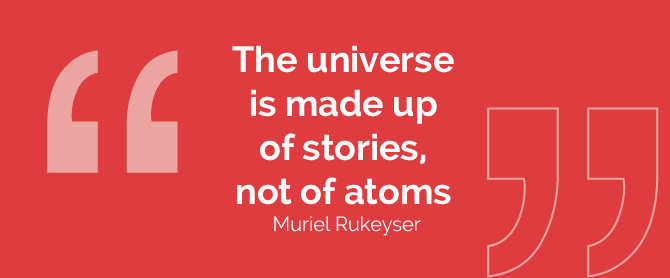
storyatoms

Every culture has its own way of telling stories, but one thing remains the same the world over (as it has been since the first story was told) — stories, both telling and hearing them, is at the heart of the human experience.

Stories inspire us, move us to act, teach us, entertain us and connect us.

We tell stories to other people and listen to others share their stories with us because stories are ultimately meant to be shared. It is the sharing of stories that drives the connection we, as human beings, crave.

storytelling-webitcongressDOTcom

Whether it is a story as complex as that told by Tolkien in the Lord of the Rings or as simple as what I did this morning, if a story is told well, the potential impact it can have is immense.

From childhood, we learn that a good story is something to be treasured. It is something we hold on to, remembering it for years if not forever.

The value we place on a good story, combined with the shared experience such a tale can generate, shows why the ability to tell a good story is so vital to success in any field.

Whether the story is told through imagery, verbally, in print, or on social media, what matters is the quality of the story. This is true in any industry or profession.

For example, in the advertising world, a good story ensures we remember a product and, later, share the story told to sell that product with others, thereby creating a second-generation “advertisement.”

For photographers and journalists, a good story is at the heart of the profession. Good stories by these professionals enhance society as a whole, informing citizens of what is going on around them, enabling them to better participate in societal discourse. The information presented by journalists, however, doesn’t resonate unless the story is good.

CEO’s have to consistently tell their company’s story in an effort to inspire investors or shareholders and potential clients/customers. If you, as the head of a company, cannot tell a good story about what your organization does and why it does it, you are going to have a hard time getting others to follow you or believe in your company.

Ultimately, however, we all want to be able to tell good stories because this ability helps us connect with those around us. We all want to associate with someone who can entertain, inspire and enthrall us with a good story. We all want to be the person who others want to listen to. Understanding how to tell a story and what elements make up a good story enables us to achieve this goal.

We are told stories from birth and start telling them shortly thereafter. What separates those of us who can tell a good story from those who can’t is practice and an understanding of what moves others…and this is the case in any industry or situation.

Digital Communication, Uncategorized

The 4 A’s of Journalistic Success

I’m going to give you, the journalists of the future, some advice.

I’m going to keep it short and (hopefully) easy to remember because, if you follow these few simple rules, I have no doubt that both you — and the journalism industry as a whole — will succeed.

Why am I offering this advice? Well, because your success as a journalist matters a great deal to me. I not only want you to be successful, I want journalism itself to thrive.  Journalism has proven to be invaluable throughout our nation’s history and I want that to remain the case.

That said; there is more to reporting than shooting something with an iPhone and posting it on your Facebook page.

You, as the reporters of tomorrow, will shape our nation’s societal discourse. You will educate a country. You will provide context, depth and information. You will perform a vital public service.

You should do this to the best of your ability and cut no corners.

You can do this by adhering to the 4 A’s. So, without further ado, here’s my advice (a word that also begins with A).

  1. Accurate: When you enter the real world, you will be under incredible pressure to meet deadlines and to get stories out to the public first. But, remember, wrong information fast is FAR worse than correct information slightly delayed. It only takes one wrong story for you to lose your credibility as a journalist. Check your information before you report it as fact. Your readers/viewers/listeners deserve the true story and you should expect nothing less of yourself. No matter what medium you choose to deliver your story, above all else, ensure that what you are presenting is accurate.
  2. Adaptable: The tools you use to do your job today could very well be obsolete tomorrow. Journalists who only wrote print stories for newspapers now find themselves producing multimedia pieces for the web — or out of a job. You MUST stay abreast of changes in technology and learn how to use these new tools. You have to be able to deliver the news to media consumers in a way that they are willing to pay attention to. That, today, happens to be in a mobile format. Know how to produce stories for that platform. Know social media. Don’t be afraid of change — embrace it. Be ready for the next big thing and stay adaptable. Your career in the future depends upon it.
  3. Aware: Be aware, as in self-aware. Know one thing: Your responsibility is to report the story, not be the story. You are not a celebrity.  You are a journalist with a sacred responsibility to objectively report the news to a population hungry for accurate and fact-based information. Stay humble and take pride in the quality of your work, not the number of times people recognize you on the street.  Additionally, on the topic of awareness, stay curious and remain aware of what’s going on around you. Pay attention to topics people are talking about on the street, find the stories nobody else is working on. Staying aware and looking for these opportunities, and taking advantage of them, will help you stay relevant.
  4. Aggressive: Don’t wait for stories to come to you. If you do, you’ll be behind everybody on the street with a phone and an internet connection. Get out from behind your computer and go find a story. People aren’t always going to want to talk to you. Do your best to make them. You have to work to get the story. Passive reporters are reporters without work. Everyone and everything has a story. It is your job to tell these stories and you can only do this by staying active and aggressive.

There is so much more to being a journalist, but keeping the 4 A’s in mind will set both you and the industry on the path to success.